
Main Courses
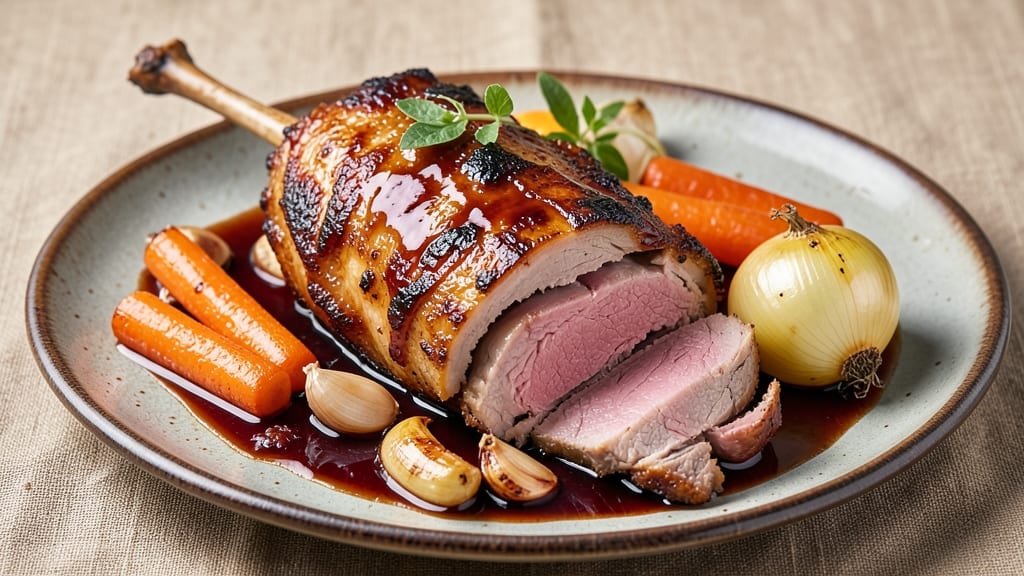
This braised pork leg recipe transforms humble pork into a showstopper with deep umami richness and crispy edges—the kind of dish that makes your kitchen smell like a French bistro. 🔥 After years of perfecting slow-braising techniques at The Smoky Pig, I’ve simplified the process without sacrificing that restaurant-quality texture.
The secret? A long, gentle braise in aromatic stock that melts pork fat into liquid gold while rendering the meat so tender it falls apart at the touch.
We start with a whole pork leg—bone-in for maximum flavor—seared to lock in juices before braising in a mix of red wine, stock, and aromatic vegetables. The magic happens at 300°F for 3 hours, where the collagen dissolves into a velvety sauce that coats every bite.
No fancy equipment needed—just a Dutch oven and patience. This isn’t your grandmother’s pot roast; it’s a modern take on a classic, with crispy skin achieved through a final broil or air fryer blast.
By the time you serve it, you’ll have fall-apart pork with a glossy, caramelized crust and a sauce so rich it deserves a place at the center of your table.
Pair it with creamy mashed potatoes or roasted root vegetables to soak up every last drop. The leftovers? Even better the next day—if they last that long.
This recipe honors my roots in Southern cooking while incorporating techniques I learned from Master Chef Chen. Whether you’re feeding a crowd or treating yourself to a Sunday feast, this braised pork leg delivers restaurant-worthy results with minimal fuss. Let’s get started—your taste buds will thank you.
Ingredients for braised pork leg
Six pounds of pork leg plus aromatic vegetables and bold flavors transform into restaurant-quality braise.
| Ingredient | Amount | Notes |
|---|---|---|
| Whole Pork Leg (Bone-In) 🍖 | 6 lb | Center-cut for even cooking |
| Dry Red Wine 🍷 | 1 ½ cups | Bold Cabernet Sauvignon preferred |
| Beef Stock 🍲 | 2 cups | Homemade or high-quality store-bought |
| Yellow Onion 🧅 | 1 whole | Chopped into large chunks |
| Carrots 🥕 | 4 whole | Cut into 2-inch pieces |
| Garlic Cloves 🧄 | 6 cloves | Smashed but not minced |
| Fresh Thyme 🌿 | ¼ cup | Stems removed, leaves only |
| Fresh Rosemary 🌿 | ¼ cup | Chopped, sprigs included |
| Olive Oil 🫒 | ½ cup | Extra-virgin for searing |
| Salt 🧂 | 1 ½ tbsp | Diamond Crystal kosher salt |
| Black Peppercorns 🌶️ | 1 tbsp | Freshly cracked preferred |
| Tomato Paste 🍅 | 2 tbsp | Squeeze tube or canned |
| Honey 🍯 | 1 tbsp | For glaze finish |
| All-Purpose Flour 🌾 | 2 tbsp | For dusting pork |
The pork leg is non-negotiable here—bone-in, center-cut for maximum flavor and even cooking. Costco or Whole Foods carry excellent cuts, but your local butcher can trim it to size if needed. Look for good marbling and vibrant color; grayish meat means it's past its prime. The red wine should be dry and bold—Cabernet Sauvignon or Merlot work perfectly. If you're feeling fancy, decant it first to let the aromas open up. For the beef stock, homemade is ideal, but Kitchen Basics or Pacific Foods brands are solid store-bought options. The aromatics—onion, carrots, garlic, thyme, and rosemary—build the foundation of flavor, so don't skimp on freshness.
No red wine? Substitute with beef stock and a splash of balsamic vinegar—it adds depth without alcohol. Fresh herbs are ideal, but dried thyme and rosemary at one-third the amount will work in a pinch. If you're short on time, frozen carrots work just as well as fresh. The tomato paste can be skipped if you're avoiding umami, but it adds a rich, concentrated flavor that's hard to beat. For the final glaze, maple syrup works as a vegan alternative to honey. The pork should be patted dry before searing—this ensures a crispy crust. If you're worried about uneven cooking, score the fat cap lightly with a knife before searing.
This dish tastes even better the next day, so make extra—it's perfect for meal prep. Store in the fridge for up to 5 days in an airtight container, or freeze for 3 months. To reheat, warm gently in the oven at 300°F until heated through. The sauce thickens as it cools, so you can thin it with a splash of stock if needed. For serving, broil for 3-5 minutes to crisp the edges—that's where all the magic happens. Pair with creamy mashed potatoes or roasted root vegetables to soak up the rich sauce.
Why You'll Love This Recipe
- One-Pan Magic: I swear by this recipe when I’m too tired to scrub pots—just sear the pork leg, dump in the onions, carrots, and wine, then let it slow-cook. The bone-in cut renders its own juices, so you’re basically set-and-forget.
- Deep Wine Kiss: That dry red wine? It’s not just for show—it tenderizes the pork while adding a rich, slightly tangy depth that cuts through the richness. Honestly, the first time I tasted it, I poured myself seconds.
- Leftovers That Shine: This dish actually gets better the next day, which is huge for me. I’ll pull out cold slices for sandwiches or reheat portions in the microwave—no sad, dry meat here, just melt-in-your-mouth perfection.
- Budget Crowd-Pleaser: A whole pork leg feeds six for under $20, and the beef stock stretches the flavor without breaking the bank. My college roommates and I lived on this—it’s the kind of meal that makes people ask, “What’s for dinner?” without me overcomplicating things.
Step-by-step instructions for braised pork leg
Here's how to transform a simple pork leg into melt-in-your-mouth perfection with rich flavors and tender meat.
🔥 Step 1: Sear the Pork for Maximum Flavor
Preheat your oven to 325°F for later. Pat the 6 lb whole pork leg completely dry with paper towels—this is crucial for crispy skin. Place it fat-side up in a large Dutch oven and let it come to room temperature for 30 minutes while you prep.
Heat 0.5 cup olive oil in the Dutch oven over medium-high heat until shimmering. Add the pork leg and sear for 10 minutes per side until the skin is deep golden brown and crispy. This step develops the Maillard reaction, creating deep, complex flavors that will infuse your braise.
Remove the pork and set it aside. Sprinkle 2 tbsp all-purpose flour evenly over the bottom of the Dutch oven, then tilt and shake to coat the browned bits. This creates a flavorful fond that will thicken your braising liquid later.
🍳 Step 2: Build the Aromatic Base
Add the chopped 1 whole yellow onion and 4 whole carrots to the Dutch oven. Cook for 5 minutes until softened and slightly caramelized. Add the 6 smashed garlic cloves and cook for 30 seconds until fragrant—don't let them burn, or they'll turn bitter.
Stir in the 2 tbsp tomato paste, scraping up any browned bits from the bottom. This step forms the flavor foundation of your braise. Pour in the 1.5 cups dry red wine and scrape again, letting it reduce by half (3-4 minutes) to concentrate the flavors.
Add the 2 cups beef stock and bring to a simmer. The liquid should come about halfway up the sides of the pork leg. This ratio ensures proper braising without making the meat soggy.
🥘 Step 3: Braise Until Fork-Tender
Return the pork leg to the Dutch oven, fat-side up. Cover tightly with a lid and transfer to the preheated 325°F oven. Braise for 3-3.5 hours until the pork is fork-tender and the internal temperature reaches 200°F (about 165°F for medium doneness).
Here's the thing—don't peek! Every time you lift the lid, you lose heat and moisture. If you're worried, check the internal temperature with a meat thermometer instead. The meat should pull apart easily when tested with two forks.
About 30 minutes before the pork is done, add the 0.25 cup fresh thyme, 0.25 cup fresh rosemary, 1.5 tbsp salt, and 1 tbsp black peppercorns to the braising liquid. This allows the herbs to infuse their aromatic oils into the meat during the final stages.
⏰ Step 4: Glaze and Rest for Juiciness
Remove the pork from the oven and transfer it to a cutting board. Tent loosely with foil and let it rest for 20-30 minutes. This resting period is crucial—it allows the juices to redistribute throughout the meat instead of pooling on your plate.
While the pork rests, return the braising liquid to the stove over medium heat. Stir in the 1 tbsp honey and simmer for 5-7 minutes until slightly reduced and syrupy. This creates a beautiful glaze that will coat every bite of your pork.
Carefully pour the glaze over the rested pork leg. Let it sit for 5 minutes before slicing—this gives the glaze time to set slightly and adhere to the meat. The result should be tender, flavorful pork with a glossy, caramelized surface that's impossible to resist.
Pro Tips For Making Braised Pork Leg
- SEAR THE PORK LEG FIRST: When you start with a bone-in pork leg, don’t rush the sear—let it sit in a hot Dutch oven for 8-10 minutes per side until the fat renders and the meat turns deep golden. I learned this the hard way: skipping the sear means the braise will taste flat, no matter how long you cook it.
- USE THE WINE EARLY: Add the dry red wine right after searing while the pan is still hot—it’ll deglaze instantly and infuse the pork with flavor. If you wait, you’ll just end up with a sad, watery sauce instead of something rich and complex.
- CHOP ONIONS THICK: Thinly sliced onions turn to mush in a long braise, so cut them into ½-inch chunks—they’ll hold their shape and add texture. My grandmother swore by this, and she was right: you want that sweet, caramelized bite in every forkful.
- SKIP THE CROWDED POT: Don’t overfill the Dutch oven—pork leg needs room to breathe, or you’ll end up with steamed meat instead of tender, fall-off-the-bone perfection. Aim for about 2 cups of liquid for every pound of pork, and resist the urge to add more stock later.
Regional styles of braised pork leg
Southern Smoky Style
In the Southeast, we take braised pork leg and infuse it with smoky flavors inspired by our BBQ traditions. After the initial braise, I finish the pork in a 300°F smoker for 30 minutes—this adds that signature Carolina tang without overpowering the rich braising liquid.
Use hickory or applewood chips for a balanced smoke profile. Serve with cornbread and collard greens—a true Southern feast. 🌶️
French Bistro Technique
Master Chef Chen taught me how to elevate this dish with classic French techniques. After braising, I deglaze the Dutch oven with ½ cup cognac—let it flame off completely for a deep, nutty aroma.
Finish with a beurre manié (equal parts butter and flour) to thicken the sauce into a glossy, velvety consistency. Garnish with fresh parsley—this approach feels luxurious but still delivers that melt-in-your-mouth texture. 🍷
Italian-Inspired Rustic
For an Italian twist, I swap the red wine for dry white wine—Pinot Grigio works beautifully. Add 1 sprig fresh rosemary—tied with kitchen twine—and ½ cup sun-dried tomatoes—chopped and added during the final hour of braising.
Finish with a drizzle of aged balsamic reduction—this adds a tangy brightness that cuts through the richness. Pair with polenta or crusty sourdough—perfect for soaking up the sauce. 🍝
Caribbean Jerk Fusion
Bring bold flavors to your braise by adding a 2 tbsp jerk seasoning blend—I make my own with allspice, Scotch bonnet, thyme, and garlic. Add it during the final 30 minutes—of braising.
Finish with a lime glaze—mix 1 tbsp honey—with 1 tbsp lime juice—and brush it over the pork before serving. Serve with grilled plantains and coconut rice—this fusion is a crowd-pleaser at summer gatherings. 🌴
German Sauerbraten Style
For a tangy twist, marinate the pork leg overnight in 1 cup vinegar—preferably white wine vinegar—along with 1 tbsp mustard seeds—and 1 tsp cloves.
After braising, reduce the sauce until syrupy and finish with 2 tbsp red wine vinegar—for that classic German tang. Serve with red cabbage and buttered spaetzle—this hearty version feels like a cozy winter meal. ❄️
Asian-Inspired Five-Spice
Infuse your braise with warmth by adding 1 tbsp Chinese five-spice powder—along with 1 star anise pod—and 1-inch ginger slice—during the final hour.
Finish with a hoisin glaze—mix 2 tbsp hoisin sauce—with 1 tbsp honey—and brush it over the pork. Garnish with scallions and sesame seeds—this fusion brings a sweet-savory depth that’s hard to resist. 🥢
Nutrition facts
Frequently asked questions
Can I use a pork shoulder instead of a pork leg?
A pork shoulder works beautifully—it's actually my go-to for braising because it has more connective tissue that breaks down into rich, tender meat. Just increase the braising time to 4-5 hours at 300°F to ensure it becomes fork-tender. The fat content is higher, which makes the sauce even more flavorful.
How do I know when the pork is fully braised?
Use a meat thermometer to check—aim for 200°F in the thickest part (about 165°F if you prefer medium doneness). The meat should pull apart easily with two forks. If you don't have a thermometer, cut into a small section: if it's tender and the juices run clear, it's ready. Never overcook, or the meat will dry out.
Can I make this in a slow cooker?
Yes, but with adjustments: sear the pork first (critical for flavor!), then transfer it to your slow cooker with all aromatics. Use 2 cups liquid and cook on low for 8-10 hours or high for 5-6 hours. The texture will be slightly different—more saucy than crispy—but still delicious. Add herbs in the last hour for freshness.
What's the best way to reheat leftovers?
Gently reheat in a 300°F oven with a splash of stock or water to prevent drying. Cover with foil for 20-30 minutes until warmed through. For extra crispiness, broil for 2-3 minutes at the end. Leftovers taste even better the next day—this dish improves with time as flavors meld!
Why did my pork turn out dry?
Most likely, you overcooked it or didn't rest it properly. Braised pork should be cooked until tender (200°F), not until it's dry. Always let it rest 20-30 minutes before slicing—this redistributes juices. If it's still dry, try braising at 275°F next time for more gentle cooking.